Moving the Industry Forward: Black Innovators in Transportation
This February marks the 50th anniversary of Black History Month. This month is a time to honor the achievements, contributions, and resilience of Black Americans throughout U.S. history and culture.
In recognition of this legacy, we’re highlighting some of the prominent people who made lasting contributions to the transportation industry.
Andrew Jackson Beard. National Inventors Hall of Fame.
Andrew Jackson Beard
Andrew Jackson Beard is best known for his several rail car coupler patents. After losing his leg coupling rail cars, he invented the “Jenny Coupler.” This invention allowed rail cars to be connected and disconnected remotely, lowering the risks of injury for future rail car workers.
For his coupler design, Beard was inducted into the National Inventors Hall of Fame in 2006, 85 years after his passing.
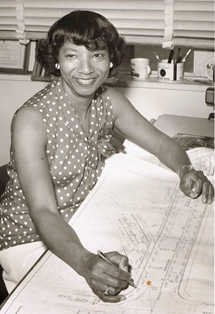
Lois Cooper, 1960. Caltrans.
Lois Cooper
Lois Cooper was a trailblazer for women and minorities in engineering. In 1953, she became the first Black female transportation engineer for the California Department of Transportation (Caltrans). She played a critical role in designing major Southern California freeways, including the I-105 Century Freeway. She was also the first female director of the First Diamond Lane, which is the precursor to carpool lanes.
Frederick McKinley Jones, 1950. Minnesota Historical Society.
Frederick McKinley Jones
Self-taught mechanical and electrical engineer, Frederick McKinley Jones, had over 60 patents to his name. Most famously, he invented a system for mobile refrigeration to allow the transportation of perishable food, transforming the food distribution industry. He also patented the gas engine starter, and a control device for internal combustion engines.
Jones was the first Black person to win the National Medal of Technology, posthumously awarded to him in 1991.
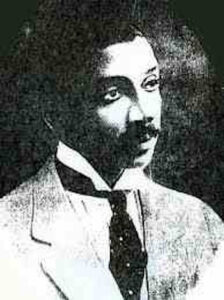
Lewis Latimer, 1882. Queens Borough Public Library.
Lewis Latimer
In 1874, Lewis Latimer co-patented an improved water closet for railroad cars, making it safer and more appealing to use. He worked alongside other inventors such as Alexander Graham Bell and Thomas Edison.
Latimer also invented a carbon filament to use in light bulbs, which made the bulbs cheaper and longer lasting than Edison’s original design, and was hired by Edison soon after.
Elijah McCoy, 1895. Henry Ford Collection.
Elijah McCoy
Elijah McCoy was a fireman and oiler for the Michigan Central Railroad. In 1872, he developed a “lubricating cup” to automatically oil steam engines on trains. This drastically improved efficiency by eliminating the need for frequent stops for lubrication of the engine.
Other inventors attempted to sell their own versions of the lubricating cup, but most companies wanted the authentic device for their trains, or “the Real McCoy.”
Garrett A. Morgan. The Western Reserve Historical Society.
Garrett A. Morgan
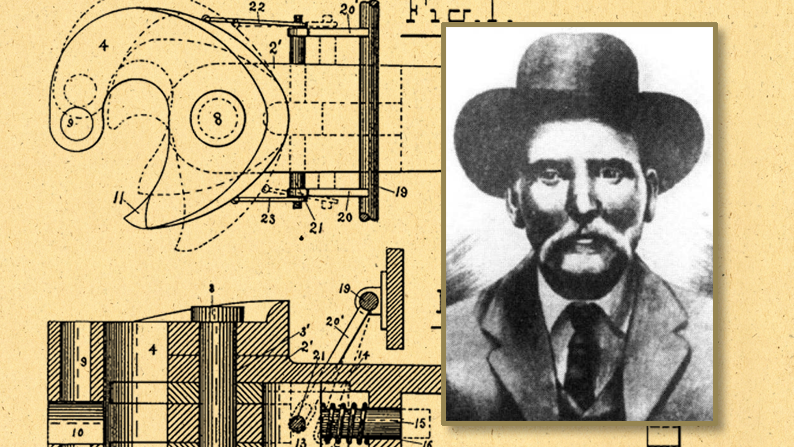
Garrett A. Morgan invented the automatic three-position traffic signal, a precursor to the modern traffic light. Before his invention, traffic signals were manually operated with two instructions – stop and go. Morgan’s traffic light had a stop position for traffic from all directions, including an intermediate step between that cleared the intersection. Today, we know it as the yellow light.
Garrett A. Morgan’s traffic signal, 1923. United States Patent Office.
Richard Spikes. African American Registry.
Richard Spikes
Richard Spikes held dozens of patents to his name and made many contributions to the transportation industry, including the gear shift transmission system in 1932 and an automatic safety braking system in 1962. Spikes is also credited with improving the invention of directional signals or turn signals as they’re known today.
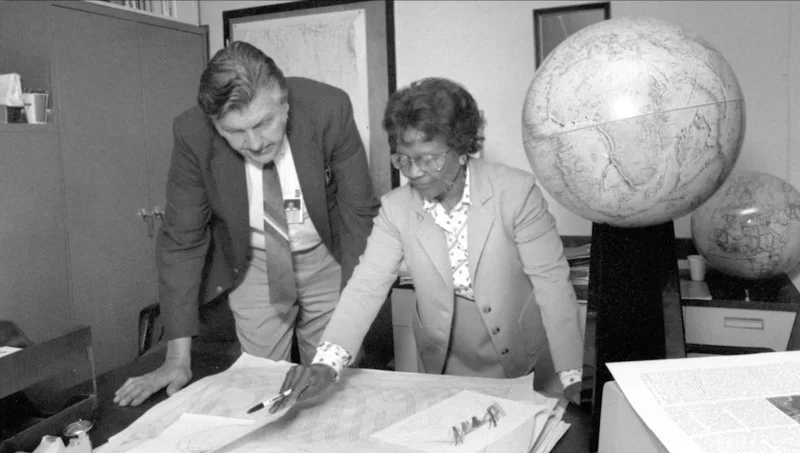
Gladys West, 1985. U.S. Navy.
Gladys West
Gladys West is one of the unsung heroes behind GPS technology. She developed mathematical models used to map the Earth’s shape accurately, which is essential to satellite-based navigation. GPS powers truck routing and fleet management, as well as aviation navigation, everyday driving apps, and more.
West passed away on January 17, 2026, at the age of 95. Next time you use GPS in your cab or car, thank Gladys West!
Granville T. Woods, 1895. The Cosmopolitan Magazine.
Granville T. Woods
Granville T. Woods, known as the "Black Edison," was a self-taught engineer and inventor who held more than 60 patents. His most notable invention being the Synchronous Multiplex Railway Telegraph, which allowed trains to communicate with stations while moving, drastically improving railroad safety, helping to prevent collisions.
Woods also founded the Woods Railway Telegraph Company. His work laid the foundation for modern train signaling and communication systems.
NTDAW runs Sept. 13–19, and several companies are celebrating with special deals and promotions for truck drivers throughout September.
Lorem ipsum dolor sit amet, consectetur adipiscing elit. Suspendisse varius enim in eros elementum tristique. Duis cursus, mi quis viverra ornare, eros dolor interdum nulla, ut commodo diam libero vitae erat. Aenean faucibus nibh et justo cursus id rutrum lorem imperdiet. Nunc ut sem vitae risus tristique posuere.
This year's Operation Safe Driver Week is July 12-18. Here's everything you need to know.
Lorem ipsum dolor sit amet, consectetur adipiscing elit. Suspendisse varius enim in eros elementum tristique. Duis cursus, mi quis viverra ornare, eros dolor interdum nulla, ut commodo diam libero vitae erat. Aenean faucibus nibh et justo cursus id rutrum lorem imperdiet. Nunc ut sem vitae risus tristique posuere.
A driver’s PSP score plays a key role in hiring, pay, and career opportunities, making safe driving and a clean record essential. Read more about PSP monitoring, self-reporting requirements, and protecting your career.
Lorem ipsum dolor sit amet, consectetur adipiscing elit. Suspendisse varius enim in eros elementum tristique. Duis cursus, mi quis viverra ornare, eros dolor interdum nulla, ut commodo diam libero vitae erat. Aenean faucibus nibh et justo cursus id rutrum lorem imperdiet. Nunc ut sem vitae risus tristique posuere.